

In the modern jewelry market, Ouros Jewels prioritizes technical facts and diamond integrity over traditional marketing narratives. When selecting a lab grown solitaire ring, know how the chemical and physical specifications are vital to ensure the stone meets excessive performance standards. This manual analyzes the core technical pillars Carat, Cut, and Clarity in the framework of lab grown diamond technology.
The Cut: Engineering Light Return
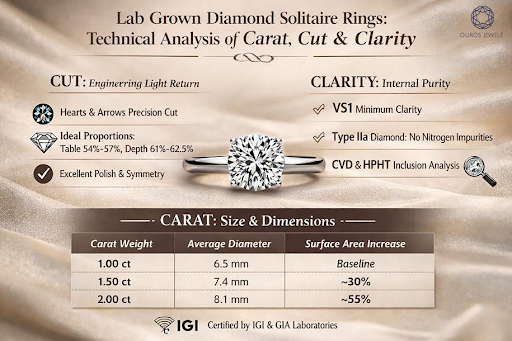
For a solitaire setting, the Cut is the most significant factor affecting the diamond’s Refractive Index. At Ouros Jewels, we focus on the mathematical precision of facets to ensure maximum light performance.
- Facet Symmetry: A “Hearts and Arrows” precision cut ensures that light is reflected internally and directed through the table, preventing light leakage.
- Proportion Standards: For a round brilliant solitaire, a table percentage of 54% to 57% and a total depth of 61% to 62.5% are the technical benchmarks for an “Ideal” rating.
- Polish and Symmetry: We recommend nothing less than “Excellent” grades to ensure the surface is free of microscopic defects that could hinder light entry.
Clarity: Analyzing Internal Carbon Structures
Lab grown diamonds, whether produced via Chemical Vapor Deposition (CVD) or High-Pressure High-Temperature (HPHT), possess unique internal characteristics.
- Inclusion Identification: CVD diamonds may contain microscopic carbon pinpoints, while HPHT diamonds might show trace metallic inclusions from the molten flux.
- Technical Threshold: For solitaire rings, Ouros Jewels suggests a minimum of VS1 (Very Slightly Included) clarity. This ensures that the crystal remains transparent and the structural integrity is not compromised by large clusters of inclusions.
- Type IIa Classification: Our lab grown diamonds are typically Type IIa, representing the most chemically pure category of diamonds with no measurable nitrogen impurities, resulting in superior transparency.
Carat: Mass vs. Millimeter Dimensions
Carat is a measurement of weight ($1 \text{ carat} = 200 \text{ mg}$), but for a solitaire ring, the visual impact is determined by the millimeter dimensions.
| Carat Weight | Average Diameter (Round) | Surface Area Increase |
| 1.00 ct | 6.5 mm | Baseline |
| 1.50 ct | 7.4 mm | ~30% |
| 2.00 ct | 8.1 mm | ~55% |
Ouros Jewels emphasizes that a lower carat weight with an “Excellent” cut often has a larger visual diameter than a higher carat weight with a “Deep” cut, as the latter hides weight below the girdle where it is not visible.
Certification and Data Accuracy
Every solitaire diamond at Ouros Jewels is accompanied by a technical blueprint from recognized laboratories like IGI or GIA. These reports verify:
- Growth Method: Confirmation of CVD or HPHT origin.
- Color Grade: Ensuring the absence of “brownish” or “blue nuancing” often found in lower-quality lab growth.
- Fluorescence: Most of our lab grown diamonds exhibit “None” to “Faint” fluorescence, ensuring the stone does not appear milky under UV light.
By focusing on these technical metrics, Ouros Jewels provides lab grown solitaire rings that meet the highest standards of diamond science and optical engineering.
